Filled gummies — dual-texture, dual-active formats for brands that want a sharper product story.
A liquid centre inside a pectin shell. Format complexity is reviewed up front so the spec lock matches what the line can hold in production.
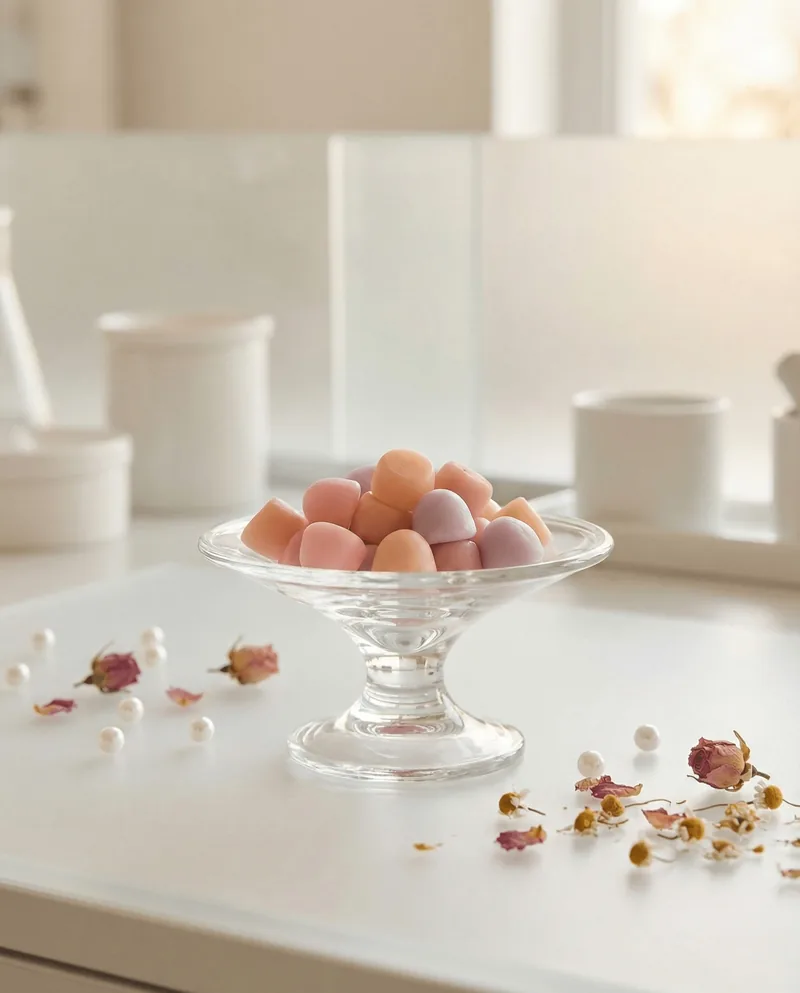
Filled gummies push the platform: a second active layer, a second sensory cue, a tighter spec. DAT confirms feasibility before locking the formula.
When a filled gummy earns its complexity
Filled gummies pay back the extra spec work when the product story needs a second beat — a dual-active stack, a sensory cue, or a premium positioning above a standard daily-use SKU.
- Beauty + energy ranges where the centre carries a differentiated active.
- Premium hero SKUs that need a richer in-mouth experience.
- Innovation pipeline SKUs stepping up from a standard gummy line into a premium dual-texture format.
What the filled-gummy platform supports
A filled gummy is a pectin shell carrying a liquid centre — typically an oil, syrup or aqueous gel that pairs with a complementary active layer. The shell follows the same pectin platform as standard gummies; the centre adds a second feasibility gate. Centre chemistry must be compatible with the shell at sealing — water activity, oil polarity and density are reviewed before spec lock. Payload is split: the shell carries the daily-vitamin or core nutrient stack at standard ratios, the centre carries a differentiating active that benefits from being isolated until consumption (an oil-soluble vitamin, a heat-sensitive botanical, a sensory cue such as a sour or cooling note). Standard finish options include sugar-sanding, oil polish and shape variations within the moulds the line can hold. Brands choose filled gummies when the product story needs a second beat — a dual-active stack a daily multivitamin alone cannot tell, a premium sensory experience above a flagship gummy, or a hero SKU that sits at the top of a beauty, energy or recovery range. The format trades the simplicity of a single-matrix gummy for a sharper editorial story; the brief review confirms whether the second active actually earns the extra spec work.
Pick the option that matches your product.
Two ways to start. The one you choose shapes the documentation you receive and the timeline, and it is confirmed with you inside your DAT Supply account.
A ready formula, your brand.
Pick a ready formula from the catalogue and add your brand. The fastest way to launch — you see the price and the minimum order before you commit, and packaging, claims and documents are confirmed with you as you build it.
- Best for
- First SKU · short timelines
- Lead time
- From 8–12 weeks
Bespoke formulation and dieline.
Fully bespoke formulation, custom flavour profile and packaging dieline. Feasibility and formulation scope are agreed first, then the project is quoted against that scope — the right option for category-defining launches with longer planning windows and committed quantities.
- Best for
- Category-defining launch · committed quantities
- Lead time
- Final timeline is confirmed during order setup.
What each option looks like for filled gummies
Private-label availability is reviewed per project — most filled-gummy launches need at least flavour or centre-active tuning, so a true private-label drop-in is not the default route. Where a ready filled-gummy formula exists in the catalogue and the brand can adopt the spec as-is, private-label can apply at the 1,000-unit MOQ tier; DAT confirms in the brief.
Custom filled-gummy development covers novel centre actives, unusual shell-centre pairings or a bespoke shape that needs its own tooling. Production MOQ is confirmed during feasibility and depends on product format, formulation and ingredient sourcing. Timelines are confirmed per project after the centre feasibility review.
PET bottle · Doypack
Filled gummies typically ship in PET bottle or doypack. Sachet packaging is reviewed per project — film and configuration depend on the centre.
Filled gummies typically ship in PET bottle or doypack. PET suits the supplement shelf and pairs well with a premium label treatment that signals the dual-texture story. Doypack works for DTC ranges that want a tactile unboxing without sacrificing barrier integrity — film selection is reviewed against the centre chemistry. Sachet packaging for filled gummies is reviewed case-by-case; the film and fill geometry must hold the centre across the supply chain, and the brief confirms whether the centre survives the sachet route. Across all packaging options, the outer carton, child-resistant closure decision, tamper evidence and shipping configuration are reviewed alongside the format choice.
- PET bottle
Canonical supplement-shelf format. Pairs well with a premium label that signals the dual-texture story.
- Doypack
Stand-up pouch with resealable zip. Strong DTC unboxing and lower secondary-packaging footprint.
- Sachet (case-by-case)
Sachet film + centre compatibility is reviewed per project before any sachet path is confirmed.
- PET bottle with premium label
- Doypack with high-barrier film
- Sachet (case-by-case)
- Tamper-evident seal
- Child-resistant cap
- Premium outer carton
- Sleeve-wrap presentation
- On-pack QR / batch code
Ready formulas in this format
A short pick from the catalogue. Positioning, claims and documentation are confirmed with you before production.
-
Beauty filled gummy
Premium beauty stack with a differentiated centre.
-
Energy + adaptogen filled gummy
Daily-use energy with a complementary centre active.
Top actives for filled gummies
Ingredients commonly reviewed for this format. Open a dossier to see dose anchors, working forms and formulation notes.
Other formats in the related formats group
Adjacent manufacturing formats DAT supports across the same product family.
Common actives for this format
Frequently asked questions
What does a filled gummy add over a standard gummy?
A liquid centre carried inside a pectin shell. Useful when the product story benefits from a second active, a second sensory cue, or a more premium texture.
Is a private-label option available for filled gummies?
Filled gummies typically route through personalisation or custom because the centre formulation is part of the spec lock. Private-label availability is confirmed per project.
What documentation review steps apply?
The standard four-step review model: brief review, spec confirmation, artwork review per the target-market framework, and batch-specific Certificate of Analysis with your batch.
Can a filled gummy ship in sachet packaging?
Sachet packaging for filled formats is reviewed per project. Film, fill geometry and centre compatibility are confirmed before any sachet route is locked.
What is the order of magnitude for a first run?
First production runs for this format are typically at the 2,500-unit entry tier; custom development volumes are confirmed after the development scope. Final volumes are confirmed during order setup.
How long does a filled gummy project take?
Confirmed during order setup — filled formats add a feasibility gate before spec lock, so timelines vary by centre complexity.
Continue exploring
Private-label framing, related formats and the public-ready catalogue.
- Private label
Private label filled gummies →
Ready formulas in this format, with the starting price and minimum order on every product.
- Related format
Gummies manufacturing →
Pectin-based supplement gummies — the mature DAT Supply format. Used across daily wellness, beauty, sleep and kids ranges.
- Related format
Powder sticks manufacturing →
Single-serving powder stick pack for powders, granulates and mix-in daily-routine concepts. Configuration confirmed per project.
- Catalogue
Browse filled gummies →
Every filled gummies product in the catalogue, sorted by family for quick scanning.
Start a filled-gummy project
Send your brief — DAT will review feasibility, confirm the working route, and frame the spec lock for the filled format.