Oral strips — thin-film, no-water doses for daily-use and travel ranges.
Discreet, fast-dissolve formats. Active load and film compatibility are reviewed up front so the strip behaves the same in spec as it does at point of use.
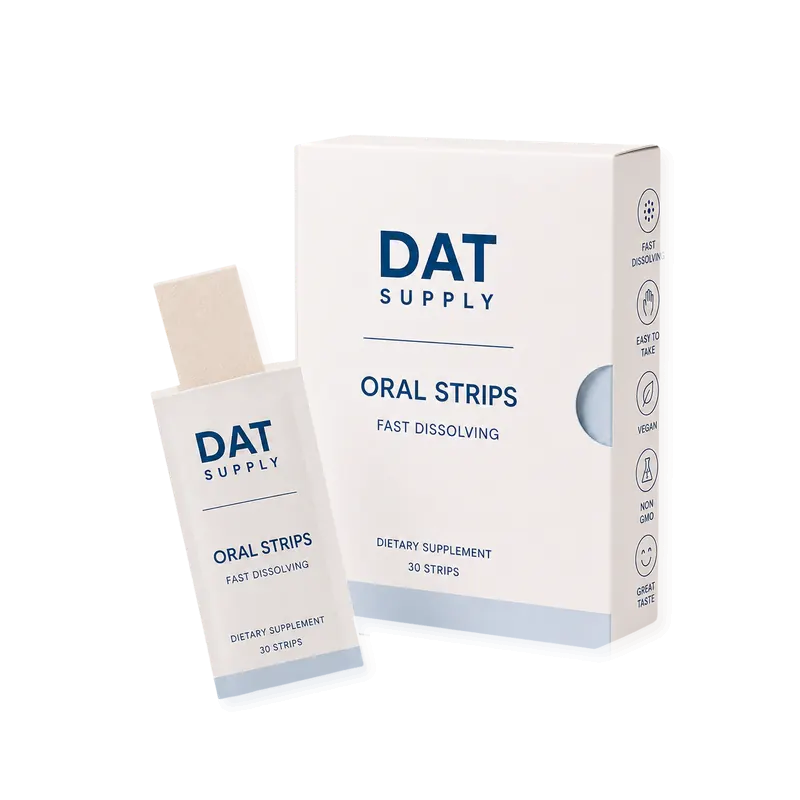
Oral strips carry the lowest active-dose ceiling of any format on the platform — film thickness is a physical limit on payload, not a formulation preference, and it rules out most high-load actives before positioning is even discussed. Where discretion, portability and no-water dosing are the brand promise, the format earns its place; DAT confirms suitability against the target active list before spec lock.
When oral strips fit
Strips suit travel-friendly, discrete-dose and on-the-go SKUs. They are a poor fit for high-mg actives or oil-based stacks — suitability is reviewed against the target active list before any spec lock.
- Travel and on-the-go SKUs (energy, focus, sleep).
- Discreet daily-use stacks where a compact no-water format is the brand promise.
- Sampling SKUs paired with a hero range in another format.
How an oral strip is made
An oral strip is a thin film cast from a water-soluble polymer system that carries the active and disintegrates fast on the tongue. The base is typically a blend of pullulan, hydroxypropyl methylcellulose (HPMC) or carboxymethyl cellulose with plasticisers, sweeteners and flavour. Payload is the platform constraint — active loading sits in the low milligram range per strip, water-soluble actives perform best, and oil-based or high-mg stacks are not the right fit. Caffeine, melatonin (where authorised), L-theanine, B-vitamins, breath actives and vitamin C variants are all routinely reviewed. The film is cast, dried, slit and packaged in wallets, booklets or foil sachets; strip thickness, dimensions and grammage are tuned to dose and dissolve time. Brands choose strips when discretion, portability and no-water dosing carry the positioning — a focus strip for travel, a sleep strip for the bedside table, a breath strip for an everyday pocket SKU. Suitability is reviewed against the active list before spec lock; the matrix has a hard ceiling on what it can carry and the brief confirms whether the target dose actually fits the format.
Pick the option that matches your product.
Two ways to start. The one you choose shapes the documentation you receive and the timeline, and it is confirmed with you inside your DAT Supply account.
A ready formula, your brand.
Pick a ready formula from the catalogue and add your brand. The fastest way to launch — you see the price and the minimum order before you commit, and packaging, claims and documents are confirmed with you as you build it.
- Best for
- First SKU · short timelines
- Lead time
- Around 8 weeks
An existing formula, adapted and produced.
Start from an existing DAT Supply formula and change ingredients, actives or dosage. Formula Adaptation starts from an existing DAT Supply formula with a fixed-fee development stage — the adaptation, one sample round and the final product specification — and production is quoted separately once the formula and specification are approved.
- Best for
- Category-defining launch · From 3,000 units per SKU (gummies)
- Lead time
- Final timeline is confirmed during order setup.
What each option looks like for oral strips
Oral strips are a Private Label lane: adopt a catalogue strip and add your brand, from 2,500 boxes. An approved flavour is configured on the order at the same unit price; a change to actives or dose is Formula Adaptation.
Formula Adaptation starts from an existing DAT Supply strip formula and adapts its actives, dose or ingredients. Novel actives, multi-layer film systems and bespoke wallet or booklet presentations are Custom Projects, reviewed individually. Sample lead time is approximately 4–8 weeks, depending on the number of sample iterations needed to reach a commercially acceptable result. Standard production lead time is approximately 8 weeks after formula/specification, artwork and payment are approved. Shipping/transit is additional.
Wallet · Strip booklet · Foil sachet
Strip packaging is reviewed per project — outer format follows positioning, retail channel and travel-claim requirements.
Strip packaging is reviewed against dose ritual and channel. Wallets carry 7, 14 or 30 strips for daily-use ranges and pair well with a slim outer carton. Booklets read premium and suit gifting or retail-led launches. Foil sachets are the travel-trial format — single-serve, light, durable. Across all options, moisture barrier matters: strips are humidity-sensitive and the film, sealing and outer pack carry the shelf life. Tamper evidence, child-resistant requirements (where the active calls for it) and on-pack claim positioning are reviewed in the brief.
- Wallet
Compact reseal wallet for daily-use or weekly-ritual SKUs.
- Strip booklet
Premium booklet format for gifting-led and retail launches.
- Foil sachet
Single-serve foil for travel-friendly trial SKUs.
- Wallet (7/14/30 strips)
- Booklet (premium gifting)
- Foil sachet (single-serve)
- High-barrier laminate
- Tamper-evident seal
- Outer carton with sleeve
- Recyclable mono-material
- On-pack QR / batch code
Ready formulas in this format
A short pick from the catalogue. Positioning, claims and documentation are confirmed with you before production.
-
Energy oral strip
Quick-dissolve energy stack for on-the-go ranges.
-
Sleep oral strip
No-water bedtime dose paired with a sleep ritual brand.
Top actives for oral strips
Ingredients commonly reviewed for this format. Open a dossier to see dose anchors, working forms and formulation notes.
Other formats in the formats & delivery group
Adjacent manufacturing formats DAT supports across the same product family.
Common actives for this format
Frequently asked questions
Which actives work in an oral strip?
Strip chemistry constrains active selection — water-soluble, low-dose actives perform best. DAT reviews the target active list against film compatibility before any spec lock.
What documentation review steps apply?
Brief review, spec confirmation, artwork review per the target-market framework, and batch release documentation with your batch.
Are oral strips a good fit for high-dose vitamins?
No — high-mg actives typically need a different format. Film thickness sets a hard ceiling on how much active a strip can carry, and DAT reviews the target dose against that ceiling during brief review before recommending the strip route or a higher-payload format instead.
Is a private-label option available for strips?
Strip projects typically route through personalisation or Formula Adaptation. Private-label availability depends on the active list and is confirmed per project.
What is the order of magnitude for a first run?
Private Label orders for this format start from 2,500 boxes; an approved flavour, colour or shape is configured on the order at the same unit price and minimum. Formula Adaptation production starts from 5,000 boxes and at least 75,000 strips per SKU.
Continue exploring
Private-label framing, related formats and the public-ready catalogue.
- Private label
Private label oral strips →
Ready formulas in this format, with the starting price and minimum order on every product.
- Related format
Powder sticks manufacturing →
Single-serving powder sticks for powders, granulates and mix-in daily-routine products, packed in boxes of sticks.
- Related format
Functional jellies manufacturing →
Pouchable functional jelly format for daily-routine and on-the-go supplement concepts.
- Catalogue
Browse oral strips →
Every oral strips product in the catalogue, sorted by family for quick scanning.
Create your oral-strip product
Pick a catalogue formula, choose your quantity and packaging, and see your price. Formula, packaging and documentation are confirmed before production.