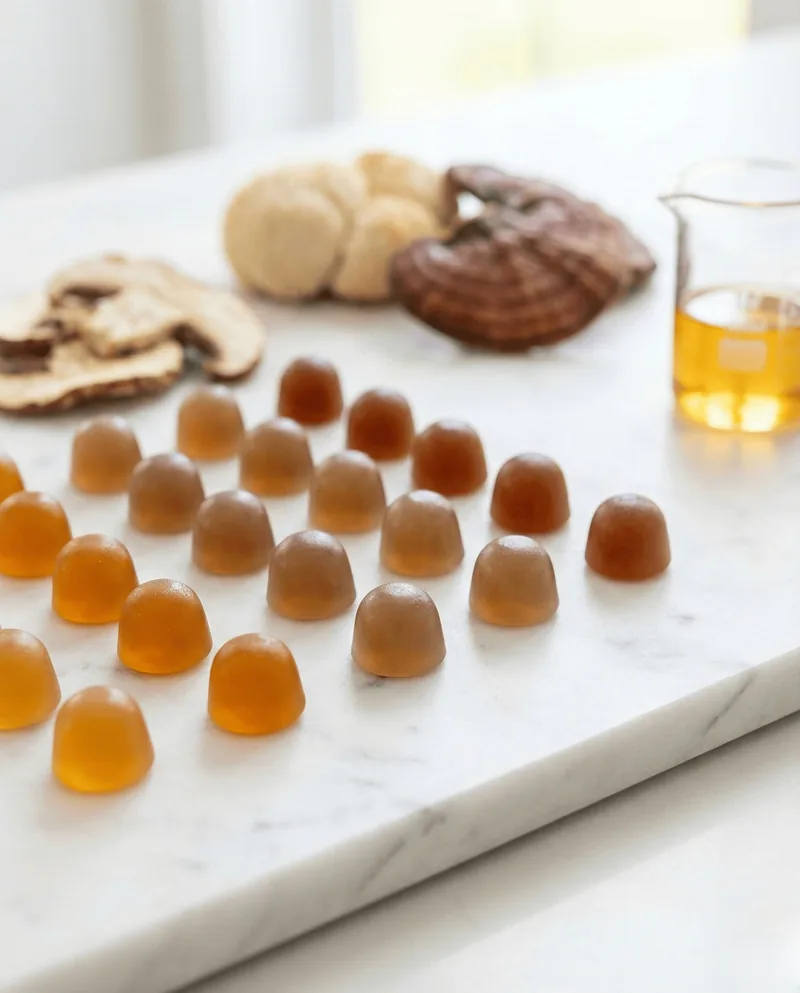
Our Non-Melting Gummy Technology delivers gummies that remain fully intact, structurally stable, and safe even when exposed to elevated temperatures. This is not achieved by packaging tricks or refrigeration. It is the result of controlled polymer physics, pH optimization, and advanced curing protocols.
This page explains the science, engineering, and commercial benefits behind our heat-stable vegan gummy formulations — and why only a few manufacturers in the world can produce gummies with this level of durability.
1. What Makes a Gummy “Heat Stable”?
To understand high-heat stability, we begin with the structural differences between gelatin gummies and pectin gummies.
Gelatin Gummies
- Melt at 32–35°C (body temperature)
- Collapse inside cargo containers
- Require strict cold-chain transport
- Unstable in high humidity environments
Gelatin is a protein-based gel. Its structure is not meant to withstand high temperatures and loses integrity rapidly once exposed to moderate heat.
Pectin Gummies (DAT.SUPPLY Standard)
- Remain stable up to 60°C depending on formulation
- Do not melt — they may slightly soften but retain full shape
- Are suitable for UAE, Saudi, Qatar, Oman, Bahrain, Kuwait shipping routes
- Do not require refrigeration or cold-chain packaging
- Are vegan, halal, and kosher compatible
The secret: Pectin’s gel matrix is thermally irreversible. Once set, it does not re-melt the way gelatin does.
2. The Science Behind Non-Melting Gummies
To achieve high-heat stability, DAT.SUPPLY modifies multiple points in the formulation and production process:
- Pectin type & DE ratio
- pH balance & acid system
- Sugar/polyol interaction
- Curing conditions
- Moisture activity control
Each of these elements influences gel strength and thermal durability. But the core science lies in pectin polymerization.
Thermal Irreversibility
When pectin cross-links during cooking and curing, it forms a network that does not revert to liquid even under heat. This is fundamentally different from gelatin, which reverts when warmed.
Controlled Water Activity (Aw)
The lower the water activity, the lower the risk of microbial growth and softening under heat. DAT.SUPPLY maintains an Aw of:
< 0.60 — safe, stable, and globally transportable.
pH Optimization
Pectin requires a controlled acidic environment to form a firm gel. DAT.SUPPLY engineers the pH to safeguard against softening during temperature fluctuations.
Typical pH for non-melting gummies:
3.2 – 3.6
Sugar & Polyol Interaction
Carbohydrates act as water binders, reducing free water and improving stability. The right combination (depending on whether the product is sugar-free or low-sugar) improves thermal resilience.
3. DAT.SUPPLY’s Non-Melting Gummy Technology Framework
Our proprietary system includes five engineering pillars:
1. Controlled Pectin Ratio
- High-methoxyl pectin for strong gelation
- Optimized DE to increase heat resistance
- Consistency across batches
2. Acid-Buffer Balancing
A dual-acid system (citric + malic or similar) stabilizes the gel across thermal cycles.
3. Active Load Stabilization
High-active formulas (creatine, electrolytes, minerals) can destabilize pectin. DAT.SUPPLY uses chelation, dispersants, or encapsulation when needed.
4. Enhanced Curing Protocol
Our curing process is adjusted based on the desired final heat resistance:
- Humidity-controlled drying chambers
- Sequential curing stages
- Temperature shock testing
5. Heat Simulation Testing
Every non-melting gummy batch undergoes a simulation of shipping conditions:
- 40°C (104°F) for 24 hours
- 50°C (122°F) for 6 hours — high-heat challenge
- Thermal cycling between room temperature and high heat
- Drop tests post-exposure
This ensures your customers receive perfectly formed gummies, even in desert or tropical climates.
4. Applications of Non-Melting Gummies in the Marketplace
High-heat stability is not a trending feature — it is a commercial necessity in global supplement commerce. Many markets cannot sustain gelatin gummies, but vegan non-melting gummies unlock new business opportunities.
Ideal Market Applications
- Middle East (UAE, Saudi, Qatar, Oman) Where summer temperatures exceed 45°C.
- Australia Where many supplements are shipped long-distance in warm conditions.
- South-East Asia High humidity + heat + long shipping cycles.
- USA (Southern States) Texas, Arizona, Nevada, Florida experience melting issues often.
- Sub-Saharan Africa Very few gummies can withstand transport conditions.
Brands that previously avoided gummies due to melting issues can now enter these markets confidently using DAT.SUPPLY formulations.
5. The Market Power of Non-Melting Gummies
Heat-stable gummies are not just a technical upgrade — they are a direct business advantage. They allow your brand to sell in markets where 95% of your competitors cannot ship gummies at all.
5.1 You Can Enter Markets Competitors Avoid
Most brands refuse to sell gummies in:
- UAE & Saudi Arabia
- Australia
- Africa
- South-East Asia
This leaves huge market gaps for brands using DAT.SUPPLY’s heat-stable technologies.
With non-melting gummies, you have almost zero competition in these regions.
5.2 Massive Reduction in Refund Rates
The #1 reason gummies are refunded in e-commerce:
“They arrived melted.”
This leads to:
- Poor Amazon reviews
- Damaged brand reputation
- Higher cost per acquisition
- Degraded lifetime value (LTV)
Heat-stable gummies dramatically reduce these issues, creating predictable and scalable operations.
5.3 More Competitive Advertising (Meta, Google, TikTok)
Brands with fragile products cannot scale ads because:
- Their CAC rises when customers complain
- Meta penalizes high refund products
- Logistics issues kill ROAS consistency
Non-melting gummies allow:
- Aggressive scale in hot countries
- Influencer & UGC content without risk
- Summer promotions without melting issues
5.4 Retail Shelf Stability (Pharmacies, Supermarkets, Gyms)
Retail stores often have unstable environmental conditions. Non-melting gummies allow your brand to be placed:
- near windows
- on open shelves
- in non-airconditioned regional stores
This gives distributors confidence to stock your product — a major advantage in expansion.
5.5 Global Logistics Are Cheaper
Heat-sensitive gummies often require:
- Cold-chain transport
- Insulated packaging
- Ice packs
- Thermal wrapping
This increases freight costs by:
20–60%
With non-melting gummies, you avoid all these costs and can confidently ship by:
- Standard air freight
- Sea freight
- Postal services
- Courier vans
This is a major margin booster.
6. The Advanced Polymer Engineering Behind Non-Melting Gummies
While pectin naturally offers superior heat resistance compared to gelatin, achieving commercial-grade non-melting gummies requires extensive optimization. This section covers the engineering variables that DAT.SUPPLY controls to ensure your gummies remain stable during transport through high-heat environments (UAE, KSA, Australia, Africa, Texas/Florida markets).
6.1 Pectin Grade & DE Selection
Pectin comes in a wide range of grades, each with different mechanical properties. The key metric for heat stability is the Degree of Esterification (DE).
- High-Methoxyl (HM) Pectin → Best for standard gummies, excellent firmness.
- Low-Methoxyl (LM) Pectin → Used for specialized gels requiring calcium cross-linking.
For high-heat gummies, DAT.SUPPLY uses an engineered HM pectin blend that delivers:
- Higher gel strength
- Superior thermal irreversibility
- Better elasticity under repeated temperature fluctuations
- Minimal water migration
This engineering choice ensures that the gummy gel network does not collapse at elevated temperatures.
6.2 Acid System Optimization (The Backbone of Stability)
Pectin gelation is pH-dependent. Without the correct acid system, gummies soften dramatically under heat.
DAT.SUPPLY uses a dual-acid strategy:
- Citric acid → primary gelation initiator
- Malic or lactic acid → secondary buffering & improved structural uniformity
This stabilizes the gummy matrix by:
- Ensuring uniform gelation
- Reducing heat-driven pH drift
- Preserving active ingredients and color
- Maintaining target water activity
Correct acid balancing is one of the biggest reasons why non-melting gummies work.
6.3 Water Activity (Aw) Engineering
Heat affects water mobility inside gummies. If the water activity is too high, heat will cause:
- Texture softening
- Stickiness
- Microbial risk
- Surface sweating
Target Water Activity for Non-Melting Gummies:
Aw = 0.45 – 0.60
DAT.SUPPLY controls water activity through:
- Precision cooking
- Sugar/polyol management
- Pectin ratio optimization
- Controlled dehydration/curing cycles
This ensures the gummies behave like thermally stable solids, not semi-fluid gels.
6.4 Sugar, Polyols & Water-Binding Systems
The carbohydrate matrix plays a major role in temperature resilience.
In sugar-based systems:
- Sucrose binds water
- Glucose syrup improves elasticity
- Combined effect reduces softening at high temperatures
In sugar-free systems:
Heat stability becomes more complex because polyols behave differently.
DAT.SUPPLY uses combinations of:
- Maltitol (great texture, moderate heat resistance)
- Sorbitol (excellent water binding)
- Erythritol (high crystallization control)
This hybrid system significantly reduces heat-driven deformation.
6.5 Anti-Softening Agents (Advanced Option)
For extreme environments (e.g., Saudi Arabia, Oman), we can include plant-based stabilizers such as:
- Locust bean gum
- Gellan gum
- Natural fibers (prebiotic matrix)
These additives increase firmness without compromising vegan status or clean label requirements.
7. Thermal Stress Testing: The DAT.SUPPLY Validation Protocol
A gummy cannot be considered truly “non-melting” unless it passes our validated stress tests. These tests simulate real shipping conditions.
7.1 Standard Heat Stress Test
All non-melting gummies are exposed to:
- 40°C (104°F) for 24 hours
- 50°C (122°F) for 6 hours
We measure:
- Weight retention
- Shape deformation
- Elastic modulus change
- Surface sweating
- Crystallization (for sugar-free variants)
Gummies must retain full structural integrity to pass.
7.2 Thermal Cycling Test (Desert Simulation)
Gummies undergo repeated heating/cooling cycles:
- 20°C → 45°C → 20°C → 45°C
- Simulating night/day temperature swings
Many factories skip this — but it is crucial for exports to GCC countries.
7.3 Humidity Chamber Tests (For High-Humidity Markets)
Non-melting gummies must also withstand high humidity. Our environmental chambers simulate:
- 40°C at 75% RH
- 30°C at 90% RH
This is required for markets like Singapore, Malaysia, Philippines, and Brazil.
8. Rheology Modeling & Texture Profile Analysis
True high-heat stability can only be achieved when the gummy matrix is engineered at the molecular level.
DAT.SUPPLY conducts laboratory-grade rheology tests to quantify:
- Elastic modulus (G’)
- Viscous modulus (G”)
- Gel strength over time
- Creep and recovery
- Compression resistance
Why this matters:
Two gummies may feel the same at room temperature — but under heat, one collapses while the other stays firm. Rheology predicts this before mass production.
Very few nutraceutical manufacturers use rheology modeling. At DAT.SUPPLY, it is standard in formula development for heat-stable gummies.
9. Packaging Engineering for Hot-Climate Gummies
Packaging is just as important as formulation. Heat accelerates oxygen permeability, moisture migration, and aroma volatilization. DAT.SUPPLY uses packaging engineering to reduce this risk.
Best Packaging Options for Non-Melting Gummies:
1. HDPE Bottles
Excellent for hot climates due to minimal light exposure and strong oxygen barrier.
2. Doypacks with High-Barrier Film
Multi-layer laminated films protect against humidity and heat. Lightweight for export.
3. PET Jars (Thick-Walled)
Premium appearance + stability. Good for beauty markets.
Optional Packaging Enhancements
- Silica packets (for high-humidity markets)
- Heat-shrink seals (prevent deformation from transport pressure)
- Anti-stick coatings (ensure gummies don’t clump under warmth)
10. SEO Comparison Section: Non-Melting vs Regular Gummies
To dominate Google for “non-melting gummies” and “heat-stable supplements,” we include a structured comparison table.
| Feature |
Non-Melting Gummies (DAT.SUPPLY) |
Regular Gummies |
| Heat Resistance |
Up to 50°C |
Melts at 30–35°C |
| Shelf Stability |
24 months |
12–18 months |
| Shipping Conditions |
No refrigeration required |
Risk of melting during transport |
| Texture |
Firm & consistent |
Softens under heat |
| Best Markets |
UAE, Saudi, Australia, Africa |
Cool climates only |
11. Commercial Applications of Non-Melting Gummies
Non-melting gummies dramatically expand the global reach of a nutraceutical brand. Most supplement companies avoid gummies in hot climates because they do not want shipping risks, refunds, or compliance issues. DAT.SUPPLY eliminates those barriers by providing a high-performance gummy that remains intact, even after exposure to harsh thermal conditions.
This unlocks entire markets previously inaccessible to traditional gelatin gummies.
11.1 Middle East (UAE, Saudi Arabia, Qatar, Bahrain, Oman, Kuwait)
The GCC region is one of the strongest supplement markets in the world — but temperatures regularly reach:
40–50°C (104–122°F)
Regular gummies melt inside:
- Delivery vans
- Airport customs warehouses
- Outdoor courier pickups
- Port logistics hubs
With DAT.SUPPLY’s non-melting formulations, brands can confidently enter these premium markets and scale aggressively.
11.2 Australia & New Zealand
Extreme summer heat + long-distance interstate shipping makes traditional gummies fail rapidly. Vegan non-melting gummies allow beauty & wellness brands to fulfill orders across the hottest regions without refrigerated trucks.
11.3 South-East Asia (Singapore, Malaysia, Philippines, Thailand)
Here the issue is **heat + humidity**. Pectin gummies excel because they resist:
- Moisture absorption
- Texture softening
- Weeping & sweating
- Flavor degradation
11.4 United States (Florida, Texas, Arizona, Nevada)
In the USA, customer complaints about “melted gummies” are one of the top refund triggers for Amazon brands.
Shipping containers, UPS/USPS trucks, and doorstep deliveries all expose gummies to unexpected heat.
Non-melting gummies give US brands a strong competitive advantage — especially for:
- Creatine gummies
- Ashwagandha gummies
- Kids gummies
- Multivitamin gummies
12. Export Documentation & Compliance Support
DAT.SUPPLY supports all regulatory documentation required to export heat-stable gummies globally:
- Certificate of Analysis (COA)
- Microbiological testing reports
- Heavy metals analysis
- Stability chamber results
- Non-melting validation data
- Halal/Kosher statements (if applicable)
- Vegan certification pathway
- Export declarations for GCC & Asia
This builds distributor confidence and accelerates onboarding.
13. Branding & Pricing Strategy for Heat-Stable Gummies
Non-melting gummies can be positioned as a premium product, enabling higher retail margins.
Recommended Brand Positioning:
- “Heat-Stable Vegan Gummies”
- “Perfect for Travel & Hot Climates”
- “Non-Melting Technology”
- “Pectin-Based — No Gelatin”