Pectin gummy manufacturing — proven platform, private-label and custom options.
Pectin-based gummy supplements formulated, packaged and documented inside a single project-managed workflow. From catalogue to custom, across PET bottle, doypack and sachet.
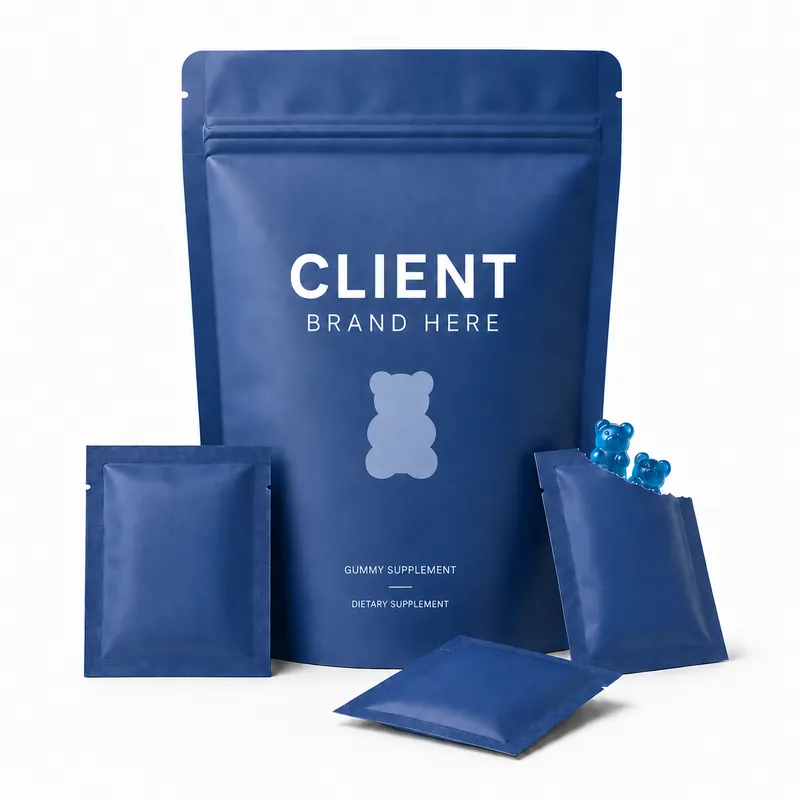
Pectin gummies are the flagship format in the DAT manufacturing portfolio. Formulation, packaging and documentation are managed end to end — not split across vendors.
When gummies are the right format
Gummies suit ranges that need broad consumer appeal, a familiar daily-ritual format, and a packaging story that reads on shelf and online. These are the launch shapes the platform handles most often.
- DTC supplement brands launching a flagship daily-use SKU.
- Established ranges extending into gummy format to broaden market reach.
- Retail private-label programmes building house lines for the pharmacy or grocery channel.
- Beauty-from-within and sports brands adding a chewable supplement to their portfolio.
How DAT pectin gummies are manufactured
Pectin is the spine of the platform. Sourced from citrus or apple, it sets the gel matrix and is reviewed alongside sugar, glucose syrup, water and a buffered acid system for pH stability. The platform supports sugar-reduced and sugar-free variants using polyols, with stevia and monk-fruit options where the active stack tolerates the resulting flavour profile. Standard payload spans water-soluble vitamins, minerals as well-tolerated salt forms, botanical extracts at extractive ratios that survive the cook, and selected amino acids. Heat-sensitive actives are dosed late in the process where feasibility allows. Colour is delivered through fruit and vegetable concentrates or approved colourants per the target market. Finish options include sugar-sanding, oil polish, sour-coating and shape variations (bears, rings, hearts, custom moulds at scale). Texture is tunable from a softer candy mouthfeel to a firmer supplement bite — pectin grade and water activity drive the dial. Brands choose gummies when broad appeal, daily-use ritual and a strong on-shelf read matter more than maximum active payload; the format trades absolute payload per piece for palatability and a multi-piece serving that paces the dose.
Pick the option that matches the brief.
Every project moves through one of two options. Final routing is confirmed inside the portal — the option shapes the documentation set and the timeline.
Reviewed concept, your brand.
Pick a reviewed concept from the catalogue and add your brand. The fastest path from brief to launch — packaging, claims and documentation are reviewed against the target market. Project-specific packaging, flavour, colour or shape adjustments may be reviewed after order start.
- Best for
- First SKU · short timelines
- Lead time
- From 5–12 weeks
Bespoke formulation and dieline.
Fully bespoke formulation, custom flavour profile and packaging dieline for qualified 5,000+ unit projects. Available after a paid feasibility/R&D review — the right option for category-defining launches with longer planning windows and committed quantities.
- Best for
- Category-defining launch · committed quantities
- Lead time
- Final timeline is confirmed during order setup.
What each option looks like for gummies
Private-label projects start from a reviewed concept already in the manufacturing catalogue. The brand owner provides artwork and channel detail, DAT confirms the target-market documentation pack, and the project moves through artwork review and a single batch release. Typical first runs land at the 1,000-unit MOQ tier for PET bottle, with packaging and outer pack confirmed in the brief. This route suits ranges that need a fast time-to-shelf flagship: a vitamin D₃ daily, a beauty stack, a sleep ritual SKU.
Custom development covers bespoke formulation — a novel active stack, an unusual matrix requirement (sugar-free with a specific polyol, a colour-free natural variant), a shape outside the standard tooling, or a packaging story that needs its own qualification. Brief review confirms feasibility before spec lock; first-run volumes are confirmed after the development scope. Custom timelines are scoped in the R&D package.
PET bottle · Doypack · Sachet
Packaging is independent of positioning. The same formulation concept can move across packaging types — DAT confirms the right fit during the brief.
Gummy packaging is reviewed as a system, not a SKU finish. PET bottle remains canonical for the supplement shelf — 30, 60 and 90-day daily-use formats with a clear nutrition table, child-resistant or standard caps depending on the market, and an outer carton or shipper that survives the channel. Doypack pouches read DTC-first, lower secondary-packaging footprint, and pair well with subscription cadence. Sachet packaging is used for single-serve daily-ritual SKUs and travel formats — film, pieces per sachet and outer presentation are confirmed per project. Across all three formats, the brand owner remains the food business operator on pack, and artwork is reviewed against the target-market framework before production. Tamper-evident seals, child-resistant closures, recyclability claims and on-pack QR codes are all routinely reviewed.
- PET bottle
Canonical supplement-shelf format. Suits 30/60-day daily-use ranges with a clear nutrition table.
- Doypack
Stand-up pouch with resealable zip. Strong DTC unboxing and lower secondary-packaging footprint.
- Sachet
Single-serve daily ritual or travel SKU. Sachet configuration (pieces per sachet, film, outer) is confirmed per project.
- PET bottle (30/60/90-day)
- Doypack with resealable zip
- Sachet (single-serve)
- Child-resistant cap
- Tamper-evident seal
- Outer carton or shipper
- On-pack QR / smart label
- Recyclable mono-material
Reviewed concepts for this format
A short pick of reviewed concepts. Final positioning, claims and documentation are confirmed per project.
-
Vitamin D₃ daily gummy
Reviewed concept for daily-use immune support.
-
Beauty hyaluronic + biotin
Beauty-from-within stack for skin and hair routines.
-
Sleep magnesium + L-theanine
Evening relaxation stack in a gummy format.
Top actives for gummies
Ingredients commonly reviewed for this format. Open a dossier to see dose anchors, working forms and formulation notes.
Other formats in the gummy family group
Adjacent manufacturing formats DAT supports across the same product family.
Common actives for this format
Frequently asked questions
What base does the DAT gummy platform use?
Pectin. The platform is pectin-first across PET bottle, doypack and sachet formats. Gelatin is out of scope.
Can the same formulation ship in multiple packaging formats?
A reviewed formulation concept can move across PET bottle, doypack or sachet packaging. DAT confirms the right fit during the brief.
How are projects routed?
Private-label adapts a reviewed concept and brand artwork. Personalisation adjusts dose, flavour or active stack within an existing matrix. Custom development covers bespoke formulation and packaging.
What documentation does DAT release at each project stage?
Four stages: brief review, spec confirmation, artwork review per the target-market framework, and batch-specific Certificate of Analysis after QC release. The brand owner remains the food business operator on pack.
Can DAT support multi-market EU + UK + US launches?
Yes — every project is reviewed against the target-market framework (EU FIC, UK FSA, US DSHEA) so the same formulation can move across pathways with the right documentation pack.
What is the order of magnitude for a first production run?
Private-label projects start from 1,000 units (PET bottle; doypack from 2,500). Personalisation starts from 2,500 units. Custom development volumes are confirmed after the development scope. Final volumes are confirmed during order setup.
Continue exploring
Private-label framing, related formats and the public-ready catalogue.
- Private label
Private label gummies →
Reviewed concepts in this format, pivoted for the private-label brand owner. Same four-step documentation route, catalogue-led.
- Related format
Sachets manufacturing →
Single-serving sachet format for powders, granulates or compact daily-routine concepts. Configuration confirmed per project.
- Related format
Functional jellies manufacturing →
Pouchable functional jelly format for daily-routine and on-the-go supplement concepts.
- Catalogue
Browse gummies concepts →
Every public-ready PIM concept detected as gummies, sorted by family for quick scanning.
Start a gummy manufacturing project
Send your brief — DAT will review and confirm the working route, packaging fit and documentation set inside the project workflow.