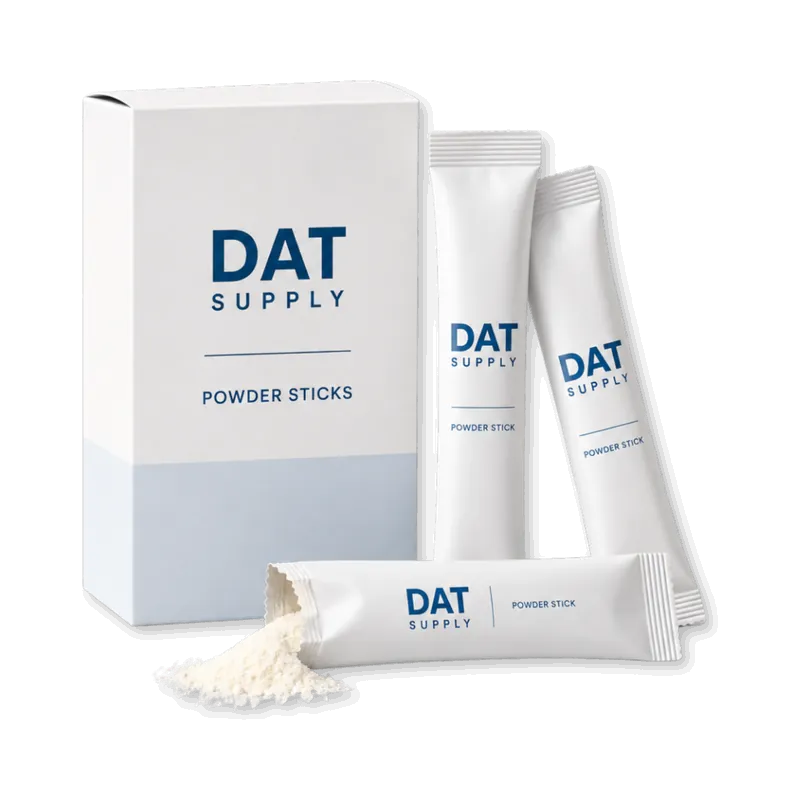
Who it's for
Common Minnesota brand archetypes: clinical wellness, retail consumer health, outdoor lifestyle. Active metros include Minneapolis, Saint Paul, Rochester. Brand owners here evaluate powder stick as a launch format.
Configure, sample and produce your supplement range in one place.
Minnesota supports clinical-leaning wellness, retail consumer health and outdoor-lifestyle brands across Minneapolis, Saint Paul and Rochester. Single-serving powder sticks for powders, granulates and mix-in daily-routine products, packed in boxes of sticks.

Common Minnesota brand archetypes: clinical wellness, retail consumer health, outdoor lifestyle. Active metros include Minneapolis, Saint Paul, Rochester. Brand owners here evaluate powder stick as a launch format.
Single-serving powder sticks for powders, granulates and mix-in daily-routine products, packed in boxes of sticks.
Open a product below, order a sample, then place your order in your DAT Supply account — serving brands in Minnesota, including Minneapolis.
Powder stick · Beauty & Skin
Minimum order 3,000 boxes
Powder stick · Beauty & Skin
Minimum order 3,000 boxes
Powder stick · Beauty & Skin
Minimum order 3,000 boxes
Powder stick · Beauty & Skin
Minimum order 3,000 boxes
Powder stick · Daily Vitamins
Minimum order 3,000 boxes
From 3,000 boxes
Documentation, sample rounds and production timelines are coordinated remotely with brand teams across the Twin Cities and beyond. Standard production lead time is approximately 8 weeks after formula/specification, artwork and payment are approved. Shipping/transit is additional.
Minnesota has Saint Paul as its capital and Minneapolis as its largest commercial city, serving a population of 6 million. Key cities include Minneapolis, Saint Paul, Rochester, Duluth. The state's distinctive supplement footprint is anchored around the Twin Cities CPG cluster (Cargill, General Mills, Target HQ) and the strong Midwest natural-products retail base. On the supplement industry signal: Target HQ (Minneapolis) + UnitedHealth + Mayo Clinic Rochester healthcare corridor. Minneapolis is a top-three US CPG private-label sourcing market thanks to Target HQ. For brand owners briefing DAT Supply, Minnesota is treated as a US-market launch operating under federal DSHEA rules: the brand owner is the responsible label holder, the product is manufactured under 21 CFR Part 111 quality-managed manufacturing rules, and any state-specific labelling (the most common being California Prop 65) is reviewed at the artwork gate. Logistics typically run through the Twin Cities intermodal complex, which DAT coordinates as part of a single project alongside manufacturing, documentation and ingredient sourcing. Where the brand owner has multi-state ambitions, neighbouring markets are listed in the internal links below for a single artwork project covering the wider region.
Minneapolis–St. Paul carries an unusually dense CPG headquarters cluster — Target, General Mills and Cargill all sit inside the Twin Cities — and that concentration has trained a generation of private-label buyers to think in shelf-ready SKU terms before anything else. A sachet fits that instinct directly: a flat, compact single-serve pack reads as a retail-shelf item from the first sample, rather than something that needs repackaging before a buyer can picture it on a shelf.
Buying literacy doesn't rewrite the rulebook: a Minnesota label still answers to the identical federal framework as every other US state's does. Where the Twin Cities background actually pays off is in how a range gets built for a shelf — pack architecture and presentation — not in a shortcut through review.
A daily-coverage multivitamin pack is a plain retail-shelf argument in the lane: one measured pouch carrying retinyl acetate, vitamin E as d-alpha-tocopherol, menaquinone-7, a B-complex and choline bitartrate reads as a single, coherent shelf SKU rather than a formulation a buyer has to interpret. An apple-cider-vinegar metabolic pack sits alongside it as a second foundational option, both formulas a CPG-trained buyer can evaluate on sight rather than from a spec sheet.
Digestive support carries a genuine either/or for shelf planning — a plain fibre pack against a version with added postbiotic cultures — and the same pattern repeats in greens, where a fibre-led blend sits next to a mushroom-added version, both built on spirulina. A Twin Cities buyer used to stocking parallel SKUs on adjacent shelf facings recognises that pairing pattern immediately.
A Minnesota sachet range benefits from treating each pairing in the lane the way a CPG buyer already treats parallel shelf SKUs — sampled and compared before either one is committed to artwork.
Twin Cities buyers trained by Target, General Mills and Cargill's CPG density evaluate a SKU in shelf terms from the first sample. A flat, compact sachet reads that way immediately, where a jar or tub often needs repackaging before it does.
No — a Minnesota-based brand answers to the identical federal framework as every other state. The Twin Cities' buying literacy shows up in pack architecture and shelf presentation, not in the review path itself.
Yes — box design and per-case count sit inside Personalization on the existing formula. Changing the actives themselves or a label claim moves the project into Formula Adaptation.
Yes — both build on spirulina, but one is paired with extra fibre and the other with added mushrooms, a genuine either/or rather than two versions of one formula. Sampling both settles which fits a range's positioning.
Yes — the plain fibre pack and the postbiotic-added version are both live formulas, and a Minnesota buyer can evaluate them as parallel shelf alternatives before deciding whether to stock one or both.
Pick a product, choose your quantity and packaging, and see your price — serving brands in Minnesota.