Who it's for
Common Maryland brand archetypes: clinical-leaning wellness, consumer health, DTC ecommerce. Active metros include Baltimore, Annapolis, Frederick. Brand owners here evaluate powder stick as a launch format.
Configure, sample and produce your supplement range in one place.
Maryland brand owners often run clinical-leaning supplement, consumer health and DTC ecommerce lines along the Baltimore-Washington corridor. Single-serving powder sticks for powders, granulates and mix-in daily-routine products, packed in boxes of sticks.

Common Maryland brand archetypes: clinical-leaning wellness, consumer health, DTC ecommerce. Active metros include Baltimore, Annapolis, Frederick. Brand owners here evaluate powder stick as a launch format.
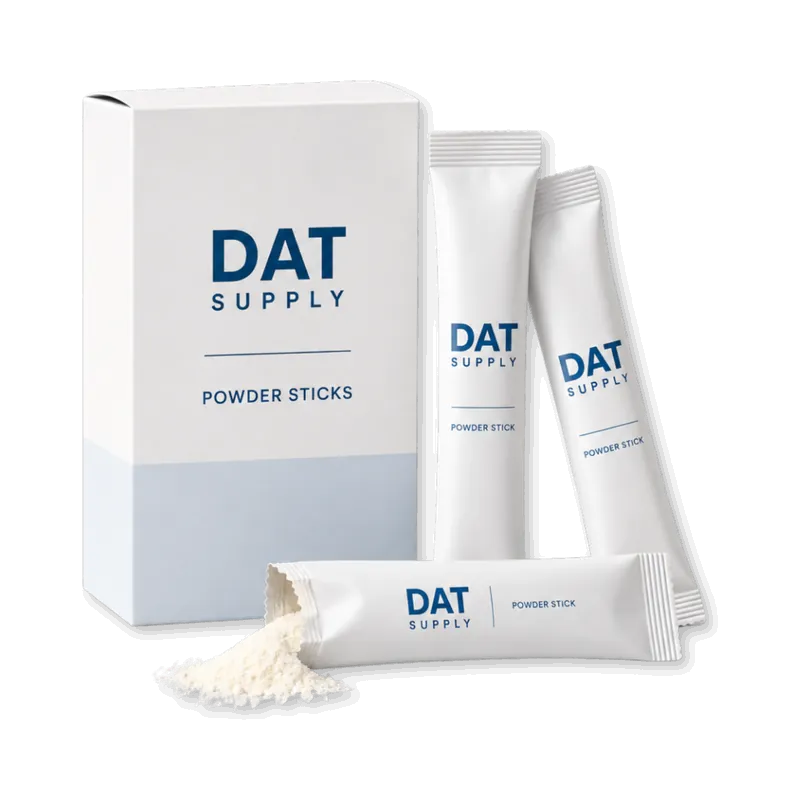
Single-serving powder sticks for powders, granulates and mix-in daily-routine products, packed in boxes of sticks.
Open a product below, order a sample, then place your order in your DAT Supply account — serving brands in Maryland, including Baltimore.
Powder stick · Beauty & Skin
Minimum order 3,000 boxes
Powder stick · Beauty & Skin
Minimum order 3,000 boxes
Powder stick · Beauty & Skin
Minimum order 3,000 boxes
Powder stick · Beauty & Skin
Minimum order 3,000 boxes
Powder stick · Daily Vitamins
Minimum order 3,000 boxes
From 3,000 boxes
Documentation reviews, samples and production milestones are coordinated remotely across each Maryland brand project. Standard production lead time is approximately 8 weeks after formula/specification, artwork and payment are approved. Shipping/transit is additional.
Maryland has Annapolis as its capital and Baltimore as its largest commercial city, serving a population of 6 million. Key cities include Baltimore, Bethesda, Frederick, Rockville, Silver Spring. The state's distinctive supplement footprint is anchored around the DC/Baltimore metro DTC cluster and the strong federal-research-adjacent supplement founder scene. On the supplement industry signal: NIH Bethesda + FDA White Oak + biotech corridor. Maryland is a Mid-Atlantic DTC founder market with strong DC adjacency. For brand owners briefing DAT Supply, Maryland is treated as a US-market launch operating under federal DSHEA rules: the brand owner is the responsible label holder, the product is manufactured under 21 CFR Part 111 quality-managed manufacturing rules, and any state-specific labelling (the most common being California Prop 65) is reviewed at the artwork gate. Logistics typically run through the Port of Baltimore (East Coast intermodal complex), which DAT coordinates as part of a single project alongside manufacturing, documentation and ingredient sourcing. Where the brand owner has multi-state ambitions, neighbouring markets are listed in the internal links below for a single artwork project covering the wider region.
Maryland's supplement founder scene sits inside the DC–Baltimore corridor, next to a concentration of federal research campuses — NIH's Bethesda campus among them — that has produced a research-literate DTC founder base rather than a traditional retail one. That audience tends to brief formulas around named actives and a clear per-serving story, and a sachet's fixed, visible measure fits that instinct better than a loose-powder tub does.
Federal rules cover a Maryland launch the same way they cover a launch from anywhere else — proximity to a research campus doesn't change what a label has to answer to. What it does change is the brief that arrives: specific, ingredient-literate, and ready to sample rather than still being drafted.
A daily-coverage multivitamin pack is a plain fit for a research-minded Maryland range: it carries retinyl acetate, vitamin E as d-alpha-tocopherol, menaquinone-7, a B-complex and choline bitartrate in one measured pouch, reading as a considered foundational SKU rather than a catch-all. Cognitive positioning gets two live entry points rather than one — a guaraná-based energy-and-focus sachet and a nootropic-leaning premium version share L-theanine, L-tyrosine and choline bitartrate but land at different intensities, so a brand can sample both before picking a lane.
Digestive support is broken out the same way a research-literate buyer would expect: a plain fibre pack sits next to a version with added postbiotic cultures, a genuine formulation fork rather than one fixed SKU. None of these need explaining with a claim beyond what the per-sachet measure already communicates on its own, and each one ships as a formula that already exists rather than a concept still being scoped for a Maryland brief.
A Maryland sachet project benefits from the same discipline its founder base already applies elsewhere: settle the shortlist, then the pack architecture, then the claims file.
Sample both: the guaraná-based formula and the nootropic-leaning premium version share L-theanine, L-tyrosine and choline bitartrate but land at different intensities. A research-literate audience tends to want that comparison in hand rather than on a spec sheet.
No — a Maryland-based brand answers to the identical federal framework as any other state. Proximity to research campuses like NIH Bethesda shapes the founder culture and the brief, not the compliance process itself.
Yes, within Personalization — flavour, colour and box artwork are open on the existing formula. Changing the actives, the fill weight or a claim moves the project into Formula Adaptation.
Yes — a version with added postbiotic cultures sits alongside the plain fibre pack as a genuine second formula, not a variant of the same one. Both can be sampled before a range decision is made.
No — the format's fixed, visible per-serving measure is the same nationwide. What the Maryland context changes is the kind of brief a founder arrives with: specific and ingredient-literate rather than broad.
Pick a product, choose your quantity and packaging, and see your price — serving brands in Maryland.