Who it's for
Common Maine brand archetypes: clean-label craft brands, natural wellness, outdoor lifestyle. Active metros include Portland, Lewiston, Bangor. Brand owners here evaluate powder stick as a launch format.
Configure, sample and produce your supplement range in one place.
Maine supports a strong base of clean-label, craft-leaning natural wellness brands serving specialty retail and ecommerce audiences. Single-serving powder sticks for powders, granulates and mix-in daily-routine products, packed in boxes of sticks.

Common Maine brand archetypes: clean-label craft brands, natural wellness, outdoor lifestyle. Active metros include Portland, Lewiston, Bangor. Brand owners here evaluate powder stick as a launch format.
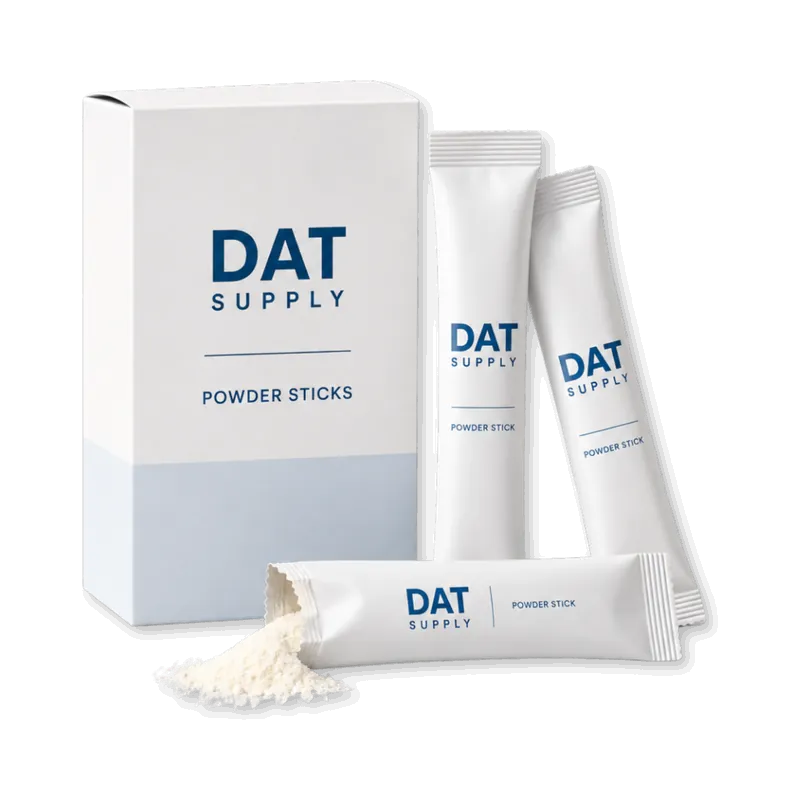
Single-serving powder sticks for powders, granulates and mix-in daily-routine products, packed in boxes of sticks.
Open a product below, order a sample, then place your order in your DAT Supply account — serving brands in Maine, including Portland.
Powder stick · Beauty & Skin
Minimum order 3,000 boxes
Powder stick · Beauty & Skin
Minimum order 3,000 boxes
Powder stick · Beauty & Skin
Minimum order 3,000 boxes
Powder stick · Beauty & Skin
Minimum order 3,000 boxes
Powder stick · Daily Vitamins
Minimum order 3,000 boxes
From 3,000 boxes
Brand owners review formulation briefs, packaging and production milestones with DAT Supply remotely at each stage. Standard production lead time is approximately 8 weeks after formula/specification, artwork and payment are approved. Shipping/transit is additional.
Maine has Augusta as its capital and Portland as its largest commercial city, serving a population of 1 million. Key cities include Portland, Bangor, Lewiston, Augusta. The state's distinctive supplement footprint is anchored around the Portland and Bangor natural-products and outdoor-active DTC clusters. On the supplement industry signal: Coastal botanical sourcing + niche premium-DTC brands. Maine is a Northeast natural-products founder market. For brand owners briefing DAT Supply, Maine is treated as a US-market launch operating under federal DSHEA rules: the brand owner is the responsible label holder, the product is manufactured under 21 CFR Part 111 quality-managed manufacturing rules, and any state-specific labelling (the most common being California Prop 65) is reviewed at the artwork gate. Logistics typically run through the Port of Portland (Maine), which DAT coordinates as part of a single project alongside manufacturing, documentation and ingredient sourcing. Where the brand owner has multi-state ambitions, neighbouring markets are listed in the internal links below for a single artwork project covering the wider region.
Maine's supplement scene concentrates around Portland and Bangor, where a run of small natural-products and outdoor-active DTC brands has built a distinct, ingredient-led founder culture rather than a big-box retail push. A brand working from that base tends to brief formulas around recognisable actives rather than a wide private-label catalogue, and a sachet format supports that instinct directly: a single measured pouch reads as considered and ingredient-forward in a way a tub of loose powder does not.
Nothing about that founder culture changes the rulebook, though: a US supplement label answers to the federal framework wherever it ships from, Maine included. What a Portland- or Bangor-based founder actually gains from that geography is a sharper starting brief, not a shorter compliance path.
The evening side of the lane is a genuine either/or for a Maine range: a melatonin-based deep-sleep formula sits opposite a melatonin-free calm-night alternative built on L-theanine and lemon balm. A brand chasing sleep support and a brand chasing a gentler wind-down aren't forced onto the same SKU. Both dissolve into a warm drink rather than needing to be chewed, which suits a bedtime routine better than counting out gummy pieces before bed does.
Daytime positions round out the range: a beauty pair (a premium collagen sachet and a vegan hair-skin-nails formula, both built on d-biotin and astaxanthin) and an apple-cider-vinegar metabolic pack extend the same single-serve logic, and a fibre-forward digestive pack adds a third daily-routine option. None of these need refrigeration or a shaker bottle — an advantage worth noting for a founder shipping direct to a spread-out New England customer base.
Settling a Maine sachet range works cleanly when the evening-versus-daytime split is decided before a single formula is sampled, since it changes which SKUs belong on the shortlist.
It depends on the audience: the melatonin-based deep-sleep sachet targets sleep onset directly, while the melatonin-free calm-night alternative built on L-theanine and lemon balm suits a gentler wind-down claim. Sampling both against a target customer profile settles the choice.
No — labelling and claims sit under the federal framework wherever a US brand ships from, Maine included. There's no separate state step to plan around, only the standard sampling and claims-review work.
Flavour and box artwork sit inside Personalization on the existing formula. An adjustment to the active blend, the fill weight or a claim moves the project into Formula Adaptation instead.
Yes — the premium collagen sachet and the vegan hair-skin-nails formula both build on d-biotin and astaxanthin, a recognisable-actives story that fits a founder culture built around named ingredients rather than vague wellness claims.
No — the format is shelf-stable and ships flat, with no glass or refrigeration requirement, which matters more for a founder shipping direct across a spread-out New England territory than it would for a dense urban market.
Pick a product, choose your quantity and packaging, and see your price — serving brands in Maine.