Artwork runs in German
Label artwork, on-pack copy and retail packaging for Germany are written in German. Plan translation and claims review alongside sampling so production is not waiting on artwork.
Configure, sample and produce your supplement range in one place.
Private-label functional-jelly (jelly stick) manufacturing for pouchable, on-the-go concepts. DAT Supply is your contracting supplier and manages the product, production and documentation workflow, reviewed for German brands.

How to choose a manufacturing partner for German brands — a reviewed catalogue, documentation by stage, and one structured order workflow.
DAT Supply supplies private-label food supplements for German brands across multiple formats.
Three things matter most: a reviewed formula base, a documented specification process, and clear claim wording for the market you sell in — before a sample is ever produced.
A private-label catalogue option that has already been through formulation review, rather than a formula built from zero for every enquiry.
Specification, label and batch documents released at defined project stages — not bundled into a single opaque handoff at the end.
On-pack copy and claim wording reviewed against the framework that applies for German brands, before artwork is locked.
Brands for German brands typically weigh a local co-packer against an EU-wide or international manufacturing platform. Neither is right by default — it depends on volume, format range and how many markets the brand plans to enter.
Can suit a single-market launch with a narrow format range and simple logistics — but often means starting from scratch when the brand adds a second market or a second format.
One structured order workflow across formats and markets, with documentation reviewed per project against the rules of each market you sell in — useful once a brand plans to sell beyond a single market.
A single contracting party for the full private-label build: formula, specification, samples, documentation and production, managed through one client workspace.
Gummies, sachets, functional jellies, oral strips and pet soft chews run through the same order flow, so a formula can move between formats without starting over.
Each project moves through defined review steps — product, specification, artwork, release — inside one client workspace, not a vendor inbox.
You choose the format. The same formula can move between packaging types without starting over.
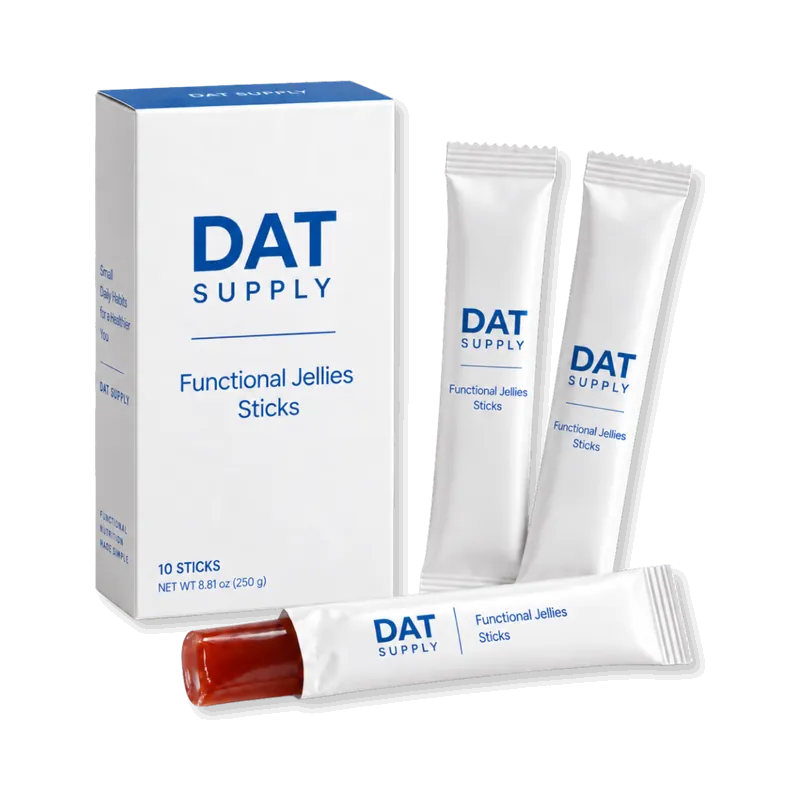
Pouchable functional jelly format for daily-routine and on-the-go supplement concepts.
Pectin-based supplement gummies — the mature DAT Supply format. Used across daily wellness, beauty, sleep and kids ranges.
Single-serving powder sticks for powders, granulates and mix-in daily-routine products, packed in boxes of sticks.
Jelly-stick production cooks the pectin matrix with the sweetener and flavour system, holds it at a controlled temperature, then doses the hot mass into stick-pack film before it sets. The stick format constrains fill viscosity on both sides — too thin and the stick underfills, too thick and it will not deposit cleanly — so viscosity and set time are confirmed at sample stage before a production run.
Private-label catalogue
Your brand on a reviewed catalogue option. Project-specific personalisation is reviewed after order start.
Formula Adaptation
An existing DAT Supply formula adapted to your product — actives, dosage or ingredients — through a fixed-fee development stage, with production quoted after approval. A genuinely new formula is a Custom Project.
Final option, packaging configuration and minimum order quantity are confirmed as you build the product inside your DAT Supply account. Final timeline is confirmed during order setup.
Ready Samples, or a Personalization Sample where the product offers one, let you confirm taste, texture and format before committing to a full order.
Packaging options include stick packs and pouches, with pack configuration confirmed per order. Samples are ordered inside your DAT Supply account, ahead of the full production run.
Each step is reviewed before the next review step opens.
Format, quantity and claims direction, reviewed for German brands.
Private-label catalogue or Formula Adaptation — confirmed with you.
Per-product specification and allergen statement drafted, then confirmed.
Confirm format, finish and packaging with a sample before the full run.
Dieline and on-pack copy reviewed against the rules of the market you sell in.
Production runs through the controlled workflow; batch-release documents issued with your batch.
Each document is released to the brand owner at its project stage. A Certificate of Analysis or independent lab testing is available on request.
DAT releases the standard documentation package by project stage. Independent lab testing is available on request.
Production is reviewed against the relevant EU/UK food-supplement framework: NRV-based labelling and permitted-claim wording are checked per project before artwork is locked. Importer, responsible-party and customs responsibilities are confirmed for the applicable order and destination. Claim wording reviewed against EU 1924/2006 and 432/2012 before production.
Germany is a market of approximately 84,000,000 people, with Berlin as the administrative capital. Key commercial cities include Berlin, Hamburg, Munich, Cologne, Frankfurt. Label artwork and on-pack copy are typically produced in German. Requirements are reviewed for the target market before production. The brand owner remains responsible for local notification or registration where required.
Dietary supplements in Germany are regulated as a category of food. Requirements are reviewed for the target market before production. The brand owner remains responsible for local notification or registration where required. Importer, responsible-party and customs responsibilities are confirmed for the applicable order and destination. DAT supplies the documentation pack; filings are DAT's only where the agreed scope includes them. Label language and claim wording are confirmed during project review before the brief is finalised.
Label artwork, on-pack copy and retail packaging for Germany are written in German. Plan translation and claims review alongside sampling so production is not waiting on artwork.
Reading the brand-owner signal for Germany: the applicable notification route and label language are reviewed for the target market before production. The brand owner remains responsible for local notification or registration where required; DAT supplies the documentation pack and does not file on the brand owner's behalf.
Jelly stick brand owners for German brands usually plan around three parallel routes to shelf: the Apotheke pharmacy channel, drugstore retail through dm-drogeriemarkt and Rossmann, and scaled direct-to-consumer. Each shapes the jelly stick format differently. Pharmacy buyers scrutinise dossier depth, drugstore category managers weight facing economics and multipack cadence, and DTC lets you test single-stick sampling before committing full artwork. Because this is the largest single EU supplement market, listing decisions run through professional category buyers rather than a founder's inbox, so pack architecture and per-stick unit economics get set at the brief stage, not retrofitted after a first production run.
Running the jelly stick lane for German brands means sequencing documentation by stage against a German-language requirement and a defined notification pathway. The working language is German, so stick sleeve, carton and leaflet artwork all resolve in German before print, not translated after a proof is signed. Requirements are reviewed for the target market before production. The brand owner remains responsible for local notification or registration where required.
Plan for three at once: the Apotheke pharmacy channel, drugstore retail via dm-drogeriemarkt and Rossmann, and scaled direct-to-consumer. Pharmacy weighs dossier depth, drugstore category managers weigh facing and multipack economics, and DTC suits single-stick sampling. Because it is the largest single EU supplement market, decide pack architecture against the channel you are listing into first.
Because the working language is German, stick sleeve, carton and leaflet artwork must resolve in German before print.
A jelly stick is a soft, spoonable-texture jelly dosed in a single-serve squeeze stick — eaten directly, no water, no chewing load. The pectin-based matrix carries actives and flavour systems in a dessert-like eating experience that reads as a treat rather than a pill, which suits beauty, energy and kids positioning.
The platform runs collagen, vitamin and botanical concepts in jelly sticks; heat-sensitive actives are reviewed for the jelly process during the brief. Texture, sweetness system and stick size are confirmed at sample stage.
A jelly stick is a wetter, uncoated matrix eaten in one go, so the flavour hits all at once with no coating to delay it. A gummy can carry a coated finish (sugar-sanding, oil polish, sour-coating) that changes the first-bite impression, and it is chewed across a longer piece — the same flavour system reads differently across the two formats, which is why flavour and sweetness are judged on jelly-specific samples rather than carried over from a gummy formula.
Private-label catalogue orders start from 3,000 boxes. Formula Adaptation production starts from 60,000 sticks per SKU.
Yes. Order Ready Samples of catalogue products, or a Personalization Sample in your chosen flavour, colour or shape where the product offers one, to confirm taste, texture and format before you start a full order. Finished packaging is chosen on the order.
Claim wording reviewed against EU 1924/2006 and 432/2012 before production.
By project stage — specification and label first, then batch release and traceability documents with your batch. A Certificate of Analysis or independent lab testing is available on request.
Pick a product, choose your quantity and packaging, and see your price. Format, packaging and minimum order are confirmed as you build the product; you create your account at checkout.