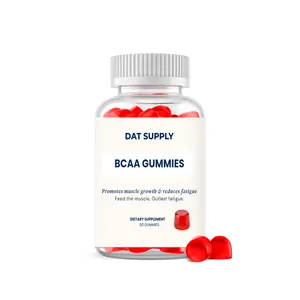
L-Leucine
L-Leucine is used in private-label supplement manufacturing. Sourcing, dose anchors and target-market documentation are reviewed per project.
- Type
- Amino Acid
- Family
- Amino acids
- Measured in
- mg
At a glance
- Format suitability
- Reviewed for gummies — confirmed per project.
Why brands use L-Leucine
L-Leucine is an amino acid commonly considered for energy, recovery and cognitive ranges, sitting in the amino acids family. On DAT Supply briefs the positioning is set by the brand brief and reviewed against the target market’s claim rules — we do not pre-position an active for any single benefit. Editorial framing uses only EU 432/2012- or DSHEA-compatible wording — we never promote unauthorised claims, even when the active has consumer-side momentum. Format-wise we have considered L-Leucine for gummies; the per-format formulation notes below describe the live constraints (taste, payload, stability, packaging) we tune in the formulation pass. Sourcing form (extract ratio for botanicals, salt or chelate form for minerals, free-form vs ester for amino acids) is reviewed against the brief, with documentation matched to the target market’s import rules. Inclusion rate and claim wording are reviewed per project — we don’t publish off-the-shelf doses.
How we use L-Leucine in formulas
A public-safe formulation reference — how this active behaves in our formats, common pairings and handling notes. Final formulation, dose and on-pack copy are confirmed per project.
- Heat stable
- Limited — use coated forms
- Soluble in matrix
- Conditional
- Vegan supply
- Project-specific
EU-authorised health claims
EU-authorised wording for this ingredient is reviewed per project against Reg. 1924/2006 and the authorised list under Reg. 432/2012. No final claim wording is implied by this page.
As a free-form amino acid L-Leucine is positioned with EU 432/2012-compatible wording where an authorised claim exists; otherwise editorial wording stays neutral and structural, focused on the active’s role in the body rather than a benefit. UK rules track EU wording. For the US market, DSHEA structure-function rules apply with the FDA disclosure. Inclusion rate is reviewed against the target positioning — sports, recovery, sleep or cognitive — and confirmed per project. Where an amino acid stack is on the brief, the per-active balance and the combined per-serving load are reviewed against the chosen format’s payload window.
Authorised at ≥15% NRV per daily serving. Claim wording must appear verbatim on consumer packaging. DAT reviews final pack copy per project against EU 1924/2006 and the authorised list under EU 432/2012.